General Writing

Why Mood Matters in a Story

Writing about writing is hard. Everything from world-building and outlining to opening hooks and sentence length has been covered so many times that finding some useful tidbit to add sometimes seems impossible. The truth is, though, that most articles repeat the same banalities and half-truths and plenty of room remains for originality. More importantly, some topics are never covered at all. As someone who started as a poet, I particularly notice the lack of discussion about mood (or atmosphere or tone, if you prefer). Perhaps as a result of this lack, many modern novels come across as flat and distant. So far as mood is created, it is usually by accident, with little control.

By “mood,” I mean the feeling that a passage invokes in a reader. In fantasy, mood used to be so common that it was a defining feature. Fantasy was supposed to be about sense of wonder, whether of awe or terror. The classic fantasies of Lord Dunsany or E. R. Eddison were all about leaving readers breathless in their descriptions of settings and events. As late as Tolkien, mood was an essential part of fantasy. Think of Tolkien’s home-like Shire, or the twilight glories of Rivendell and Lothlorien, or the wasteland that is Mordor, and you will understand immediately what I mean. The descriptions of these places are as important as the characters and plots. They are a main reason why some readers fall in love with The Lord of the Rings. A poet himself, Tolkien offers readers a poet’s eye view of his world.

Yet as fantasy has gained in popularity, mood has been de-emphasized. Part of the problem may be the amount of generic fantasy published. By definition, generic fantasy concentrates on the more superficial aspects — imitators copy elves and orcs more often than Tolkien’s worldbuilding or writing style. Another problem may be that blockbuster movies and games have made fantasy fiction a genre of action or plot, with less attention being paid to subtler aspects like mood. When attention is paid to mood, it is usually to admire the animation or green screen effects, rather than the audience’s response to special effects. As a result, mood has all but disappeared in fiction. With the emphasis on plot, mood is viewed as extraneous to the art of storytelling.

I find this state of affairs unfortunate (by which I mean, comparable to an alien invasion or a tidal wave followed by Godzilla’s relatives arriving all at once for a family reunion). Not using mood is as odd as writing an entire novel without using the letter “e”: you can do it, but why limit yourself so arbitrarily? Especially when the result is so unsatisfactory?

If you doubt what I say, take The Return of the King from the shelf and open it to “The Battle of Pelennor Fields.” The chapter describes the siege of the city of Minas Tirith by the forces of Mordor. The city is vastly outnumbered and waiting for allies who may not come. Detail after detail accumulate to create a feeling of hopelessness. As the chapter ends, Gandalf the wizard confronts the Lord of the Nazgûl, who mocks him and promises destruction. Things could not get any worse. Then:

And in that very moment, away behind in some courtyard of the city, a cock crowed. Shrill and clear he crowed, recking nothing of war nor of wizardry, welcoming only the morning that in the sky far above the shadows of death was coming with the dawn.

And as if in answer there came from far away another note. Horns, horns, horns, in dark Mindolluin’s sides they dimly echoed. Great horns of the north wildly blowing. Rohan had come at last.

Just like that, the mood of despair, that keeps readers turning the pages with growing apprehension, is replaced by relief with a sentence of five words. The entire chapter, and especially the ending, is a masterpiece of mood control, and proof enough of the importance of mood. I would call it the best writing Tolkien ever did.

But how do you capture some of the same power in your own writing? I have no idea how Tolkien did it, but I have found a technique that works for me. I start by deciding what mood I want to create, and reduce that mood to a single word, such as grief or relief or strangeness. Then I open up the thesaurus and note all the synonyms for that word.

However, I do not use that word, nor any of its synonyms. Besides being unsubtle, that would simply not work. You do not create a mood of horror by using the word “horrible.”

Instead, as I write, I try to choose words and descriptions that create that word. For instance, to give an unsubtle example, to invoke grief I might mention shadow and night, and funeral hymns. Possibly, I might choose a viewpoint of someone who grieves. One word, one phrase at a time, I work, and, if I am successful, a reader will receive the impression I want. If I want to orchestrate a change in mood, as Tolkien does, I repeat the process, and figure how I want to make the transition from one mood to another. In effect, choosing the word is a form of outlining, but for mood instead of actions.

Sometimes, the effect is as simple as a simile or a metaphor. For instance, if I write, “Silence spread like a stain,” the comparison carries a hint of the ominous, of something out of control and wrong. At other times, the effect works through an accumulation of details. For instance, in describing a keep, I could have written simply

He remembered now that the cellars and parts of the curtain wall were older still. Built by Valicon’s legions, most said, to mark the north-eastern end of an empire.

However, I wanted to create a sense of the uncanny, so I wrote:

He remembered now that the cellars and parts of the curtain wall were older still. Built by Valicon’s legions, most said, to mark the north-eastern end of an empire. Giant-built, said others, pointing at the outsized stones. Built by others, harpers said when the fire was reduced to ember. Other folk, human only by whim.

The additional two sentences and fragment steadily move readers from history to legend, to hints of the supernatural — to ghost stories. And with their addition, a snippet of info-dump suddenly becomes more interesting.

Strictly speaking, mood is unnecessary to the story. Yet by working to create it, writers can add to readers’ experience. It may even be the case that, when readers remember a scene or re-read a story, the reason may be that they have been struck by the mood.

Queries

10 Ground Rules for Comping

Comping is the comparison of your submitted novel to similar ones in a query. Personally, I have doubts about comping — is everything a hybrid of existing works? — but comps are a quick way to give a sense of your work. In fact, many agents and publishers insist on them. Not being in a position to set the rules, I am dutifully selecting comps for when I begin to query. The process is harder than it looks — much harder, I find, than writing a blurb. So far, while I’ve made some progress, what I have most learned is how not to comp.

Here are the basic ground rules I’ve set for myself:

Favorites may not make the best comp

The point is not to gush over the books I love, but to start the process of selling my book. A basic honesty is required, since I am hoping to start a long-term business relationship (and, knowing me, I would probably get caught if I pretended that I had read a book that I hadn’t), but the goal is to attract attention, to suggest I write in a certain tradition, or have a unique juxtaposition of ideas. Some of my old favorites simply would not fit with the book I’m querying.

Avoid Mentioning Other Media

I have seen some queries reference films, games, or graphic novels. While these references may work with some recipients, I plan to avoid them myself. After all, I am pitching a book, not a film or a game. Moreover, I have noticed that the more aspiring writers reference other media, the less polished their writing is usually is. Possibly, I am overrthinking things, but I want to show my competence with the written word, not with other media.

Comps should be in the genre

Sometimes, genre crossovers work. My favorite example is Lois McMaster Bujold’s A Civil Campaign, which could accurately be described as Space Opera Meets Pride and Prejudice in a Shakespearean Comedy. However, I doubt that such a juxtaposition would be well-received from a first-time writer. While some recipients might be delighted by it, I suspect more would find it too off the wall, and conclude that I have tried something too ambitious for my level of skill that would be difficult to market.

Comps May Be About More Than Style

Most writers I’ve talked to select comps in terms of plots and themes. However, they can also be marketing potential. For example, my critique partner Jessica, who lived for years in China and is married to Chinese man, is writing a novel set in a fantasy version of China. She is thinking of comping S. A. Chakraborty’s City of Brass, partly because Chakraborty is an American writing about the Muslims and married to Muslim. The implication is if Chakraborty’s background makes her novel acceptable in the age of diversity, then so is hers.

Avoid Blockbusters

It used to be that all fantasies were described as “in the tradition of Tolkien.” You won’t find that on recent releases, though. Tolkien has become so ubiquitous in our culture that the phrase has lost all meaning. If anything, using would suggest a superficial knowledge of fantasy. The same goes for Star Wars, Star Trek, and Harry Potter.

Watch for hidden pitfalls

Selecting some books would simply send the wrong message. For instance, while I generally admire Kim Stanley Robinson’s Red Mars, early in the book there are some anti-Muslim comments that are ignoant and hard to stomach. The last thing I would want is for an agent or publisher to think I approve of bigotry — especially if I submitted to someone who promotes diversity. On the whole, I think it’s a good idea to re-read a potential comp, just in case it has some passages that would sabotage me.

A comp can be misinterpreted

I briefly considered Patrick Rothfuss as a comp. What I had in mind was the fact that he tells a long, varied story. However, as my critiquing partner pointed out, most people associate Rothfuss with poetic prose. If I did use Rothfuss, I would have to make clear what aspect of his writing I referred to.

A comp should be comparatively recent

I have read fantasy for decades, and accumulated influences the way a ship hull accumulates barnacles. However, can I trust an agent or publisher to recognize an older reference? Could they take the comp as a sign I am out of touch with the market? At least one of the comps should have been published in the last few years.

Mentioning a major writer stakes too large a claim

I have been genuinely influenced by Neil Gaiman and Ursula K. Le Guin. Yet if I use either as a comp, my choice can be read as a claim that I write as well as those famous authors. I’d like to think I do, being as egotistical as any writer, but the danger is that instead of intriguing an agent or publisher, I may encourage skepticism. “Oh yeah?” they might imply. “Prove it!” And I would probably have the same reaction.

Tailor comps to the recipient

Typically, a query names two comps, or at the most three. However, before I start to query, I plan to have at least half a dozen ready to swap in and out of my queries. Being a recovering academic, I am researching agents and publishers and producing a short list before I begin to query. I fully expect that different comps will appeal to different recipients. If I can anticipate which comps appeal to which, maybe I can increase my chances.

The Question Continues

Am I asking too much of myself? Will I be able to navigate around all these complications? Probably not in a day, or maybe even a week. Yet if I can finish a manuscript and survive critiques and revisions, then I should be able to generate a few comps. Maybe when I have my list of comps, I’ll blog again and explain how I chose them.

General Writing

Working with Flop-Sweat

Mainstream culture shuns anxiety. We are taught to avoid stress, and, at the first sign of unease, we are encouraged to find a remedy in the medicine cabinet. Such attitudes may explain why those attempting to write complain so often about writer’s block, or even an inability to get started. We are so conditioned to avoid anxiety that few have considered that it might actually be beneficial — a necessary requirement to do their best work.

This belief is widespread in acting circles. At the start of a new play or film, many actors experience flop-sweat — an overwhelming sense of anxiety about the new venture. Yet far from avoiding it, actors often believe that, unless they experience that nervous edge on opening night, they are unable to give their best performance.

Similarly, years ago, when I was competing in long distance running, I regularly experienced flop-sweat before a race, although I didn’t have a name for it then. The few times I didn’t, I either lost or clocked a slow time.

Maybe flop-sweat is a superstition, but I have a more logical explanation of it. I believe that flop-sweat is unfocused nervous energy. Left unchecked, it can become distraction. However, there is another alternative. If you can focus your tension on the task at hand, it can work for you, rather than against you.

In my experience, you can focus that tension is several ways. Most of them have to do with breathing exercises combined with simple visualization. In the simplest form, the tension could be focused by slow jogging while I focused on inhaling and exhaling. In a more complicated visualization, I would imagine each breath descending through me to create a pool of energy around my diaphragm. Sometimes, I would conclude by imagining one hand raising a zipper that started at my navel and went up my neck to stop below my chin.

When the starting gun went off, I would visualize that energy expanding into my chest, arms and legs. I would start the race in a burst of energy, often taking an early lead, or at least settling in near the fron the pack. Later in the race, I found I could get a second wind by repeating this visualization. My last visualization would in the last one hundred metres. Once across the line, I would often sit or sprawl on the ground, absolutely spent, regardless of what position I finished.

Of course, writing is a less physical act than running — although some dramatic or suspenseful scenes can sometimes leave me almost as tired as running five thousand metres. However, in recent years, I find that the same breathing and visualization exercises work just as well for writing. As in a race, they set me going with a burst of energy. I writer faster than normally, and less critically. Often, I write for several scenes before I start to flag. Almost always, the results are a polished first draft. By channeling my flop sweat instead of trying to suppress it, I can make it work for me rather than against.

I have no guarantee that anyone else will have the same results as I do. Possibly, you may be too conditioned for my technique to work for you. Still, the results are worth the experiment. After all, if you are overcome by writing anxiety in one of its many forms, you’re not likely to make much progress anyway.

General Writing, Uncategorized

Software for Fiction Writers

Judging by how often would-be writers ask what software to use, you might think their choice would make them a better writer. It won’t, of course. The only useful answer is to use whatever application with which you are comfortable. However, there are other considerations, such as stability, security, and price that you might want to consider.

Here are some of the popular choices, and what you should know about them:

MS Word

For many, MS Word has the advantage of being familiar. Many, too, already have a copy of it on their computer. However, Word is not designed for files of more than about thirty pages. Manuscripts of several hundred pages can crash in Word, risking corruption.

Nor should you use Word’s infamous master document feature, which allows you to create a mini-TOC of files so that you are never working with a single bulky file. Technical writers used to say that master documents in Word are always in one of two states: corrupted and about to be corrupted. I’ve seen no evidence the situation has improved in recent releases, and, anyway, the interface is awkward.

If you must use Word, the only sane way is to use one file per chapter. Any other approach risks disaster.

Google Docs

Google Docs has the advantage that files can be accessed on any computer. If you are one of the legions of users who treat word processors like a typewriter, it may be adequate for you — and it is convenient for adding comments when you critique. However, it barely comes with styles, let alone standard features like fields that can automate your work. Possibly, a careful choice of extensions would make Google Docs tolerable, but why make the effort when other choices are available, and do the job better?

However, if you do use Docs, preserve your privacy by uploading only encyrpted files. You should take the same precaution with online storage. A variation of Pretty Good Privacy (PGP) can teach you to encrypt and explain the process.

OpenOffice & LibreOffice

Apache OpenOffice and LibreOffice are both descendants of OpenOffice.org. Both are free for the download, but LibreOffice is more streamlined and has more features. Both are far more stable than MS Word — I’ve loaded 900 page files into them without much problem, and never any corruption.

Like MS Word, OpenOffice and LibreOffice include a master document feature. However, unlike Word’s, their master document features are stable. Both also include a complete set of features to automate your work.

Scrivener and Its Alternatives

Scrivener is valued less for its word processing tools than its tools for organizing and outlining information for planning. It has numerous fans, although some admit they don’t use many of the features. Others balk at paying for the full version of the software, despite the fact that discount coupons are often available online.

If you still would rather not pay, you could use LibreOffice and develop templates that mimic most of Scrivener’s functions. You can also find free alternatives like Bibisco. Personally, I am cool towards this kind of software, finding that it creates an illusion of progress that is really busy work, but many dedicated outliners swear by it.

For me, a more practical solution solution might be to install a personal wiki. Wikis were originally designed for software developers to plan and collaborate, and support a wide variety of file formats in a single document, making them equally useful for writers. The greatest drawback is that their ever-changing content encourages chaos, but with an effort you can slow down the chaos by imposing some basic structure.

All these applications are easily available, so shop around before settling on one. If none of these suit you, there are numerous text editors that provide a minimal tool, with few distractions. In the end, it’s you, not the software, that matters.

General Writing

Dialog: It’s All About the Relationships

Fictional dialog is full of obstacles. As I suggested in an earlier blog, fictional dialog is not realistic, since it generally omits the hesitations, digressions and repetitions of actual speech. Instead, it creates the illusions of speech by imitating how most people imagine that they speak. Yet even that realization may not be enough to produce effective dialog. Too often, writers fail to think deeply about the structure of a conversation, although the essentials can be summarized as three main points: dialog is about relationships, interactions can be interpreted differently by participants, and conversations can preserve those relationships or alter them.

These insights are not original with me. They are adapted from The Pragmatics of Human Communications, one of the classic studies about how people interact. Written by by Paul Watzlawick, Janet Beavin Bavelas, and Don D. Jackson fifty years ago, it has never been out of print since, and is a standard text in psychology and communication courses. Its subjects include the structure of an ordinary conversation. It does not specifically discuss fiction, but its comments do suggest how to write effective dialog. If your dialog seems flat and lifeless, one reason may be that you are ignoring everything about your dialog except the words themselves. Or, to put the case another way, you are not giving the whole conversation, and that may be why you have trouble writing

Pragmatic’s first insight that writers can borrow is that a conversation is about more than the topic being discussed. For instance, superficially, a mother telling her son to clean his room is a request to perform a common task. However, on another level it can be about the mother’s wish to control her children and her house, and the son’s wish to be more independent. Similarly, two friends recalling a concert might be less about getting seats near the stage and getting the singer’s autograph than reinforcing the friendship. The participants are mostly unaware of this deeper level, but it explains why what might seem like a request to do a simple chore can end in a fight, or nostalgia can make friends feel closer. Dialog is not just about the topic — it’s about the relationship between those involved in the conversation.

As a writer, you may never mention the relationship. Yet understanding its importance can help you shape what each participant says. You know that the mother is aware that her son is growing away from her and on some level wants to slow the process, and that the son feel stifled. You know that the two friends are bonding as they recall their shared past. You know, too, that mother will be surprised when her straightforward request turns into an argument, or the two friends sit back and open another beer.

Another useful observation is that while certain events might occur in a conversation, the participants can interpret them differently — or punctuate them, to use the term in Pragmatics. From the mother’s perspective, she nags because her son ignores her. However, from the son’s perspective, he ignores her because she nags. Otherwise, if he didn’t ignore her, he would get angry with her and they would clash more. But which is right? From a psychiatrist’s or a writer’s point of view, it hardly matters. What matters, and what the writer can use to enhance the dialog, directly or indirectly, is the fact that the difference in opinion exists.

However, from the perspective of your characters, who is correct can matter greatly, and sometimes emerge as the dialog’s topic. As the union folk singer Utah Phillips used to tell his audience, everybody assigns blame in their own best interest. More importantly, if blame is relative, then one of the major privileges in society is who assigns blame. As a result, what punctuation is generally accepted can often be hotly debated. The son in my example, being in a subordinate position, might argue his interpretation as a means to assert his position, while the mother insists on hers in order to maintain her position. This is a point that Pragmatics does not cover, but is a natural extension of its observations: punctuation is often about power.

The third point that writers can take from Pragmatics is that whether the relationship reflected in the dialog changes depends on what the participants do or say. If the mother sees her son’s hostility, she may avoid an argument by softening her demand, or perhaps by giving him a hug. This is the definition of negative feedback — not hostile criticism, but feedback that keeps the relationship more or less as it it. By contrast, if the mother takes offense at the son’s wish for independence, her request might turn into positive feedback, encouraging him to become more surly, until the relationship finds a new balance for better or worse. As a writer, knowing whether the relationship of those talking will stay the same or change can help you know what to write.

What these points come down to is this: when you write dialog, focus on the relationship of the participants as much as the words themselves. Doing so can add realism and tension to your dialog, and, even more importantly, tell you how a conversation will develop.

Fiction

Coining Names

If your story has a conventional setting, naming characters is easy. Online lists of names for various eras and ethnicities makes the task a matter of selection rather than invention, although, as my critique partner Jessica points out, you may run into cultural considerations, such as not naming a Chinese character for a god. But if your setting is an imaginary world, your task is more difficult, and requires some forethought.

Of course, as with any names, the ones you coined should generally be evenly distributed throughout the alphabet, especially for the main characters. If each character’s name starts with a different letter, you make telling them apart easier for the reader. In the same way, varying the number of syllables can be a memory aid. Usually, too, the words should be generally easy to pronounce – unless, of course, you mean for one to be a jaw-breaker.

But where do the names come from? Despite the frequent suggestions in online writers’ group, I would discourage using Internet name generators. Not only do most of them conform to stock types like dwarves and elfs, but what is good enough for a game may not be suitable for fiction. For example, one name generator suggested “Brassica” as a name for a dryad – the scientific name for cabbages and related plants. Enough said?

One useful method is to build the name on a word that suggests how a character is meant to be regarded. For example, from “skull,” I coined the name “Skulae” for a vicious character. Even more obviously, I called a morose character with a dry sense of humor “Morgrim.” Readers may not consciously make the association, but I maintain that it still works on a unconscious level.

I have another method when I want to suggest a real life ethnicity. Many cultures use names with particular naming patterns. For example, Frankish men’s names often ended in “pert,” Germanic women’s names in “hild.” Once you have the pattern, all you need is supply the rest of the name to produce names like “Chilpert” or “Janhild.”

If you are really stuck, pick five words at random. You can select from a dictionary, or even a password generator like xkcd-pass, which uses random words. Then, recombine the results to produce original words. For example, if I picked

casually niece pushiness fifth clapper enduring

Some of the words I might generate include “Clapduring,” “Perpush,” and “Fifiece.” Nor would I hesitate to add a letter here and there to improve the result. For instance, instead of “Perpend,” I might settle on “Perpendes.”

Whatever the method, I prefer to prepare possible names ahead of time. I keep a general dictionary, and a specialized one for each culture I depict. Each of the specialized ones is based on a real language, or else the unique sounds or letter-combinations I have assigned to the culture. I currently have a dictionary of over five hundred coined names, so when I need one, all I need to do is consult my dictionaries.

Many writers coin names by other methods, such as reading a word in reverse or deliberately mis-hearing what someone said. There’s nothing wrong with such alternatives, if they give satisfactory results. However, by semi-organizing the process, I find that I get more pleasing results. Probably many of the names in my dictionaries will never be used (and, in some cases, no doubt shouldn’t be). But maintaining dictionaries of names streamlines the process, and minimizes the interruption when I suddenly need a name while writing.

Fiction

The Hero’s Journey vs The Emperor of Everything

I waited two-thirds of my life to see The Lord of the Rings filmed. When the movies finally came out, I was over the moon. The first two movies were not my Lord of the Rings, but they were recognizably related, and since no one was about to hand me the money to produce my own version, I was well-contented. Then the third movie came out – and after three hours of high drama, it stumbled at the end because of what it – and nine-tenths of fantasy leaves out.

Of course, something had to be left out, or the ten hours of movies might have stretched to forty. However, what director Peter Johnson cut while he was tidying up the third movie was not a stand-alone episode like Tom Bombadil, that might have been good fun, but did little to advance the story. Instead, it was the most vital part of the story of the Hero’s journey, how, after enduring and triumphing in a series of trials, the Hero returns home with a hard-won knowledge of self to give the benefits of his or her journey to the community.

What the third movie left out was the chapter Tolkien called “The Scouring of the Shire.” In it, Frodo, Sam, Merry, and Pippin come home to find it taken over by Saruman and his remnant of henchman and petty thieves. Having traveled and witnessed heroic deeds, and even done a few themselves, the four hobbits quickly overcome the remnants of Saurman’s forces, and settle down to what – for Sam in particular – is the lifelong task of restoring the Shire to its former glory. In this task, they are aided by everything they have brought back frm their troubles, including their weapons and the livery of Gondor and Rohan, but Galadriel’s gift to Sam of a box of dirt and an acorn from her garden. In the most literal sense, what they have obtained on their travels is applied to their home. From this perspective, “The Scouring of the Shire” is not just part of an epilogue that Tolkien seems reluctant to end, but the payoff for the entire story. It is the end of the Hero’s journey, the part that makes the whole story archetypal and justified.

Omitting this part, and the story is incomplete. At best, it is an adventure story that fails to engage readers on any level that matters. At worst (and far more commonly), it is a power fantasy, the story that Norman Spinrad years ago called in an essay called “The Emperor of Everything.”

So what is wrong with a power-fantasy? Nothing, from the point of view of sales. You can hardly open a book, watch a film, or play a game without seeing The Emperor of Everything retold for the millionth time under another title. The story has a certain appeal to adolescents lacking a sense of identity. More importantly, in industries that depend on a steady stream of interchangable product, The Emperor of Everything requires little thought. Its producers can concentrate on promotion and not worry details like plot. What room is left for creativity can go for spectaculars, long-drawn out battles at the climax that only have to bedazzle, not to make sense.

But the Hero’s journey, the structure that powers myth and art, is more about that. The Hero’s journey is the transition from adolescence to hard-won adulthood. It is the story of the education of the Hero (who is at once both unique and Everyman), and giving the culture meaning. It is never about gaining power, wealth, and status for yourself. In a word, it is what separates art that we remember and cherish from an entertaining read or view that is quickly forgotten. On the symbolic level that most of human beings’ thinking takes place, or at least most of what matters.

Tolkien knew that. In anticipation of that ending, he has Frodo and Sam on the way to Mordor speculate and joke how one day they might be famous in song. That fantasy is not an adolescent dreaming of conquering all those who laugh at them, or winning the lover of their dreams. It is their reward for undertaking the Hero’s journey and becoming worthy. But without The Return that illustrates their newfound worthiness, the story is incomplete and can never be completely satisfying.

But I am not simply ranting at the movie versions of The Lord of the Rings, much less calling out Peter Jackson for his choices two decades ago. These are simply convenient examples. My point is, if your story seems flat and generic, ask yourself: Are you writing a new version of The Hero’s Journey for your times? Or just The Emperor of Everything? Is your hero Ironman, or Odysseus Always Returning? Superficially, these may look the same, but the difference is profound.

General Writing, Uncategorized

A Thesaurus for Scene Transitions

For years, I’ve maintained that the secret of writing well is understanding structure. Most people can learn to write a pithy statement or paragraph if they are willing to put in the effort, but developing a sense of how ideas fit together is much more difficult. Nor is learning helped by the fact that we have little analysis of structure and consequently can only talk about it with considerable difficulty.

Take scene transition in fiction. We can sometimes use analogies from movie making, but, being different media, both fiction and film have transitions that the other lacks.

Finally, after years of waiting for someone else to analyze scene transitions, I thought it was time to approach the task myself, studying several dozen of my favorite novelists and short story writers for examples. This is a list of tactics I have observed so far. There are almost certainly more.

I’ll start with the obvious:

1. Continued Narrative:
In the most common transition, the story simply continues. The main artistic choice is how much time elapses between scenes: A few minutes, so that what is saved is only a few sentences of narration about something mundane, such as walking from a house to the car? Or a much longer period of hours, days, or years?

2. Flashback: The second scene happens earlier than the first. Sometimes, the first scene introduces the second. Usually, the flashback scene is shorter than the first, because readers are apt to see a flashback as a digression from the main character.

3. Infodump: Giving background information can slow a story down. One way to minimize the slow-down is to take advantage of the boost in interest created by a new chapter or scene and begin the second scene with a few paragraphs of infodump before returning to the action.

4. Collage: A variation of the infodump first developed in John Dos Passos’ USA trilogy. Short pieces of information, such as newspaper headlines or quotes from imaginary books are placed between scenes. The information informs either the previous scene or the next one, possibly both. Seemingly random, the pieces of the collage need to be carefully chosen and arranged to be effective.

5. Establishing shot: A variety of infodump in which the setting is described before anything else, even the characters. Victorian novelists made heavy use of establishing shots, but modern audiences have less patience with them, especially if they are longer than a few paragraphs.

6. Starting in the Middle (in media res): The second scene starts in the middle of the action, and what is happening is only gradually revealed This transition is handy for restoring readers’ interest – with any luck, they’ll wand to continue reading to know what’s going on.

7. Change of viewpoint: The transition also marks a change in viewpoint character.

8. Parallelism: One scene ends with a thought or image that is mirror, sometimes distorted, in the next scene. For example, one scene might end with knife chopping down at a character, and the next with another character using a knife to chop carrots.

9. Dramatic irony: What one character thinks or states in the first scene is found in the second to be incomplete, inaccurate, or wrong. This transition might be considered a variation on parallelism.

10. Comparison / Contrast: The opposite of parallelism. The second scene is markedly different or similar in setting, time of day, tone, or action. For instance, the first scene may be set at night with a lone character, while the second features multiple characters in the sunlight.

11. Cause and effect: The second scene happens because of the first. For example, because Hamlet doesn’t kill his uncle in Act 3, Scene 3, he is harsher to his mother in Act 3, Scene 4, which follows immediately afterward.

In addition, there are at least two transitions which connect a variety of shots:

12. Tracking shots: A series of scenes in which a character moves through a variety of settings or completes a task. For instance, the start of Fiddler on the Roof shows the milkman on his daily rounds, while he sings about his culture and the inhabitants of the village are introduced.

13. Panorama: A series of scenes in which each on gives a different perspective on the same event. Usually, the event is something complex, like a battle or a disaster. However, it can also be used with more subtlety. For instance, Paul Edwin Zimmer’s The Lost Prince begins with characters within a few miles of each other looking out on various parts of the same city. As the scenes progress, the sun sinks lower in the sky and finally sets.

The first three listed probably account for the structure of the majority of short stories and novels. Often, writers use the same types of transitions over and over. American fantasist Avram Davidson, whose later stories were usually intricately crafted, started nearly two-thirds of his scenes with an infodump, while science fiction writer John Brunner would use the collage to suggest the fast pace of the information age. Similarly, Shakespeare, whose plays continue to influence English-language fiction, was fond of contrasts, particularly in the first acts in which characters are being introduced. As these examples show, transitions can form a major part of any writer’s style.

That alone makes them worth a closer look. If we can identify the different types of transitions, we can talk about them with greater ease, and learn more about how to put a story together. If nothing else, on a practical level, when we are unsure how a story should continue, we can scan the possibilities and maybe see the way through – or, at least, some possibilities with which to experiment.

Plotting

A Hero’s Journey for Women

When I was a sessional instructor at Simon Fraser University, I taught children’s literature based on the concept of the Hero’s journey. After the course explored the concept with books like Ursula K. Le Guin’s A Wizard of Earthsea, in its second half it explored attempts to make the Hero’s journey fit women’s lives. The second half included Robin McKinley’s The Blue Sword, a classic Hero’s journey with a female protagonist and her The Hero and the Crown, a more innovative novel. It ended with Le Guin’s Tehanu, an exploration of uniquely female narrative that attempts to do away with traditional ideas of plot structure altogether. Since then, the question of whether women’s lives fit the pattern of the Hero’s journey continues to be debated. One of my favorite reframings of the Hero’s journey is Jody Gentian Bower’s Jane Eyre’s Sisters, which rewrites the classic pattern and introduces several new archetypes.

If you have studied narrative structures, you have probably come across the Hero’s journey. Based heavily on Jungian psychology, the Hero’s journey is an attempt by Joseph Campbell to describe the universal form of narrative – especially as a metaphor for maturation and develop. This “monomyth,” as Campbell calls it, is detailed in The Hero with a Thousand Faces. It begins with a call to adventure, in which the hero is faced with a task or a goal. The hero sets off on an actual or metaphorical road to adventure, facing trials and meeting helpful companions. After reaching a low point, the hero reaches initial maturity, but rallies to accomplish the task and goal. In the end, the hero returns home and gives it the benefit of all that he has learned.

Originally, the archetypes that the hero meets along the way, like the Wise Old Man or the Trickster were said to be part of the collective unconscious, the symbolic world that humans share by being human. However, modern Jungians sometimes suggest that some archetypes might be culturally based, and from this possibility the idea comes the concept of the heroine’s journey, a model of a woman’s life just as the original hero’s journey is a model of a man’s life. Several versions of the heroine’s journey have been proposed, among them Bower’s.

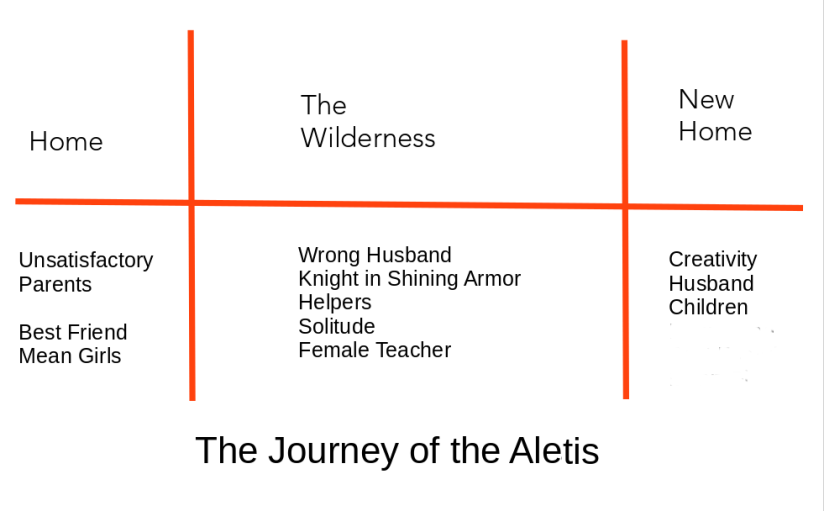
Bower’s concept centers on a wandering woman archetype called the Aletis, which she views as quite different from a male Hero. Often, the Aletis story spends considerable time at the start of the story describing a restricted home, so that the motivation for her journey is understood. Both the Aletis and the Hero undertake a journey, but while the Hero does something important, the Aletis’ journey is about gaining self-knowledge and the freedom to be herself. While the Hero is isolated on his journey, the Aletis is surrounded by friends and makeshift families. Perhaps most importantly of all, the Hero’s journey is circular, while the Aletis moves away from an unsatisfactory home to find at the end a new one where she can be herself.

These different journeys result in a different array of archetypes on the Aletis’ journey. Right at the start there is a Mother or Father figure who is cruel, indifferent, or inadequate. The original home might also include a Best Friend, a Mean Girl, and a Mentor. When the Aletis is thrust out of her original home, she may meet figures like The Wrong Husband and The Knight in Shining Armor, who at first appear to rescue her, but who are later rejected as the Aletis learns to take care of herself. In fact, much of the first stages of the Aletis’ journey consists of refusing various ties and expectations in order to be herself.

Leaving home and the temptations of other archetypes, the Aletis ventures out into a real or symbolic wilderness, sometimes in disguise. She may meet a female Teacher, sometimes one with sinister qualities, and perhaps an animal helper. Eventually, she returns to society, but on her own terms. She may find a new home, creativity, a true lover, and have children, having carved out a space where she can live on her own terms. She is less likely to transform society on a large scale, the way the Hero does, but that may also be part of what she has learned.

Such attempts to find a woman’s version of the Hero’s journey do show one thing: despite claims to universality, the pattern outlined by Campbell is primarily a male pattern. With numerous examples, taken from life and predominantly from 19th century novels by women, Bower makes that limitation obvious.

Yet I cannot help wondering whether some women might find efforts like Bower’s unsatisfactory. Granted that the word “Hero” is a term heavy with associations, does that imply that a woman cannot be as easily influential in society as a man? That a woman’s life is not as directed as a man’s? If either of these possibilities is true, does telling such stories simply perpetuate the idea that women have a limited life compared to men? Does it mean that women cannot be, in the accepted sense, heroes? What about other genders? I am reluctant to accept any of these conclusions outright because teaching has taught me that women’s brains do not differ from men’s to any extent. As a storyteller, I want to be relevant, but, at the same time, I do not want to perpetuate crippling perspectives.

Still, writers with female lead characters might want to consider efforts like Bower’s as they plan their stories. Just maybe, there are better ways to tell women’s stories than the Hero’s journey.

General Writing

The Spine of the Story

For me, one of the key concepts of writing is the spine of the story: what the story is about, or the theme, if you’re an English major. William Goldman the author of The Princess Bride, named the concept in Adventures in the Screen Trade and Which Lie Did I Tell? He was referring to screenplays, but the concept holds true for fiction as well, whether for entire novels, or for chapters, individual scenes, or even paragraphs. Until you discover the spine, your writing is apt to be directionless or colorless, except by accident.

As Goldman explains, the spine is not the plot. The plot is a sequence of events, with later event caused by earlier ones. Instead, the spine is what you want writers to think about the events of the plot. For example, imagine your plot is about how an unknown person of obscure beginnings rises to become emperor. The same events could have many different spines: how ambition corrupts, how humble people are to be relied on rather those in powers, how youthful dreams are corrupted with maturity, or any of a dozen others. Which one you choose is entirely up to you, and probably you won’t discover it until well into the first draft, or until the second. However, once you have found the spine, you know what to include and what to exclude. Sometimes, knowing the spine can also suggest new directions for the story. The same is true for sub-plots as much as main plots

Possibly, discovering the spine, it can take you out of the trap I fell into two-thirds of the way through my first draft. I kept writing, and each chapter read well in itself. However, reading my latest chapters together, I had to admit that they seemed directionless. I had lost all concept of where the story was heading, and each chapter became harder to write than the previous one. At last, as I ground to a crawl, I went back and thought about the story until I found the spine. I retreated several chapters, and I am currently re-writing with the spine in mind. So far, the result feels a far strong story. I even discovered a small sub-plot to reinforce the main one.

On a smaller scale, I wrote scene in which a small group was traveling, hoping to meet others going the opposite direction and faced with the possibility of pursuit. I told what happened, but the story had all the life of a breaded cod. So I considered the spine, and to me it was obvious that the group would be anxious– increasingly so as neither of the events anticipated happened. As simply as that, the scene had tension and was far more interesting to read.

There is a catch, however. Although Goldman did not mention the fact, I find that knowing the spine works best if your narrative never mentions it, or any near synonym. Instead, knowing the spine should be the criteria for deciding details. For example, I never once mention that my anxious group is anxious, or nervous or uneasy. Rather, the spine suggests details: everyone walks faster, they stop singing, and keep looking to their weapons. In other words, the spine I assigned tells me the kind of effects I want.

What I like about Goldman’s concept is that it is a way to think rationally about the creative problems of writing. It is not required, yet when I examine scenes I wrote without thinking about the spine, I find those that are most effective have a unity of detail similar to those written when I did. I find the spine a way around any difficulties, and a best practice as well. Increasingly, it is becoming a standard tool when I write.